> For the complete documentation index, see [llms.txt](https://docs.patchmypc.com/llms.txt). Markdown versions of documentation pages are available by appending `.md` to page URLs; this page is available as [Markdown](https://docs.patchmypc.com/patch-my-pc-publisher/technical-references/multi-tenant-support/sync-schedule-support.md).
# Sync Schedule support for Multi-tenants in Patch My PC Publisher
*Applies to: Patch My PC Publisher V3.x*
{% hint style="danger" %}
**Important**
This article has not been updated for Version 3.x. Once it has, this banner will be removed.
{% endhint %}
In a multi-tenant configuration, there is *no* independent sync schedule per tenant.
The **Sync Schedule** tab in Patch My PC (PMPC) Publisher defines a single global schedule for the entire Publisher instance. When the configured sync time occurs, the Publisher evaluates all enabled product selections across all configured tenants and processes publishing accordingly.
## Selective Sync for MSP Scenarios
Although the scheduled sync is global, MSP customers can still perform targeted publishing using the [Selective Sync right-click option](https://docs.patchmypc.com/patch-my-pc-publisher/customizations/list-customizations/republish-product.md). This allows you to manually synchronize specific applications or updates without waiting for the next scheduled sync.
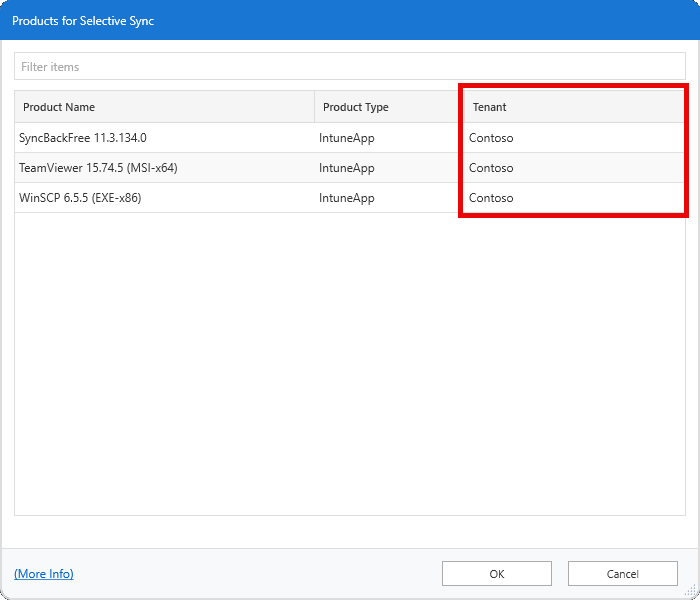
Selective Sync processes only the selected applications or updates for the currently selected tenant. This provides flexibility for MSPs who need to publish changes for a single customer without triggering a full global sync across all tenants.
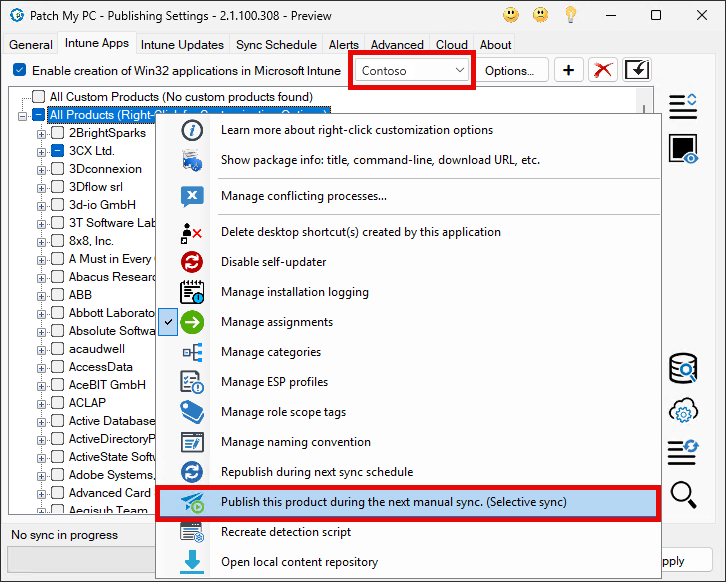
To synchronize all selected products for a **single** MSP customer, first select the tenant from the tenant drop down list. Then right click the **All Products** node and choose [Publish this Product During the Next Manual Sync (Selective Sync)](https://docs.patchmypc.com/patch-my-pc-publisher/customizations/list-customizations/publish-now.md).
This will process all enabled applications and updates for that selected tenant only.
---
# Agent Instructions
This documentation is published with GitBook. GitBook is the documentation platform designed so that both humans and AI agents can read, navigate, and reason over technical content effectively. Learn more at gitbook.com.
## Querying This Documentation
If you need additional information that is not directly available in this page, you can query the documentation by asking a question.
Perform an HTTP GET request on the following URL with the `ask` and `goal` query parameters:
```
GET https://docs.patchmypc.com/patch-my-pc-publisher/technical-references/multi-tenant-support/sync-schedule-support.md?ask=&goal=
```
`ask` is the immediate question: it should be specific, self-contained, and written in natural language.
`goal` is what the user is ultimately trying to achieve, the reason they need the answer. Sharing it helps GitBook give you a better, more relevant answer. A goal is most helpful when it describes the outcome the user wants rather than restating the question. For example, with `ask=how do I create an API token`, a goal like `automate deployments from our CI pipeline` lets GitBook tailor the answer to that use case.
The response will contain a direct answer to the question and relevant excerpts and sources from the documentation.
Use this mechanism when the answer is not explicitly present in the current page, you need clarification or additional context, or you want to retrieve related documentation sections.